Boston Busing in Chinatown
"Chinese parents are united."
330 Tremont St, Boston, MA 02116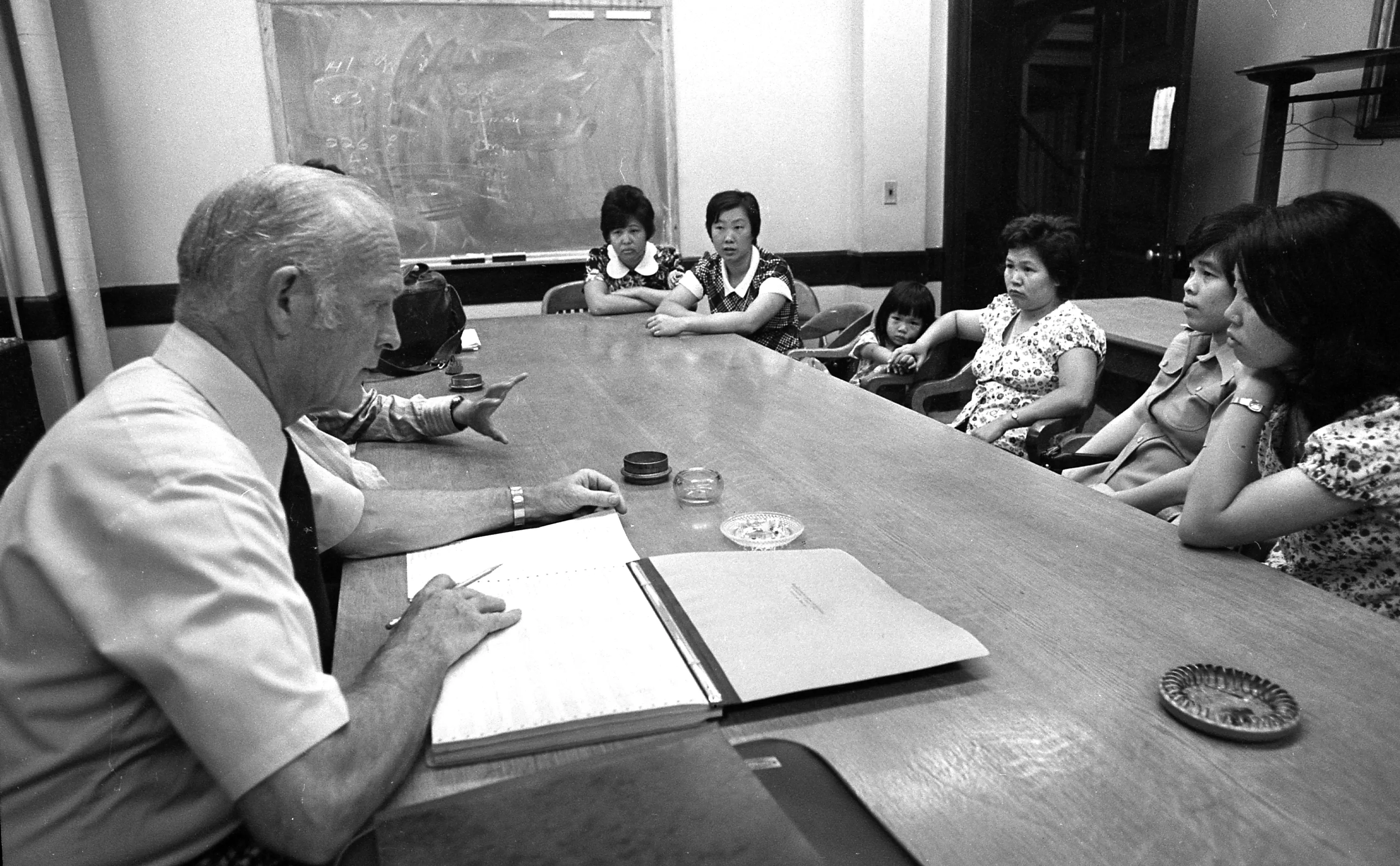
A meeting between a member of the Boston School Committee and members of the Chinese Parents Association, 1975 (Photo courtesy of the Boston Globe)
In 1975, when Boston began busing elementary school students for school desegregation, Chinatown mothers took a dramatic stand for equitable treatment in education. While the focus of the desegregation effort was equal access to a quality education, the federal court and the Boston Public Schools had not considered the plight of students other than Black and white ones, and made no provisions for Chinese or Latino concerns about safety, communications, and representation.
Chinese mothers, primarily immigrant garment stitchers, supported by a small group of young English-fluent supporters, formed the Boston Chinese Parents Association (BCPA) during a long summer of fruitless letter writing, meetings and public announcements. Their appeals to federal Judge Arthur Garrity, the Boston Public Schools, the Boston School Committee, and community leaders were ignored or met with hostility.
On the school year’s opening day, the BCPA organized a community-wide boycott of the schools. Mothers took the message to the streets, the factories, and everywhere that people gathered. They issued a press release that read, “Chinese parents are united in boycotting all schools because we feel that school and court officials, by not taking concrete action on our demands, have demonstrated an overall disregard for the rights of all Chinese parents and students.”
BCPA members telephoned every Chinese family with children scheduled to be bused to urge the boycott action. The women woke up at dawn and kept watch over the local school bus stops to inform parents. The Parents Association mobilization led to over ninety percent of the 1,000 Chinese students scheduled to be bused joining the boycott. Despite pressure from the Boston School Department and the U.S. Department of Justice, the parents continued the boycott for three days. Because of this mobilization, the BCPA won nearly all their demands for safety, communication and representation.
The Parents Association victory was an early successful example of participatory democracy, the demand for fair treatment, and greater visibility. Working class immigrant women had also successfully articulated their voice within Chinatown’s social structure. Outside of Chinatown, the BCPA forced institutions to acknowledge the Chinatown neighborhood. The parents also built new bridges to other city populations – Latino parents, Black educators and politicians, the Boston Teachers Union – carving a new role for Chinatown in Boston city politics.
“Most parents used to walk their kids to school, and I had to go by myself, so I felt she didn’t care for me. ...[With the busing struggle and the boycott] my brother and I looked at our mother in a different way–we realized that she was fighting for us.”
Source: Macy Lee, Pride and Promise, Boston Herald Sunday Magazine (1985)
Learn More
Check out more resources submitted by our community.
by Jessica Ma, Boston Globe
2025
by Phillip Martin, WGBH
2024
by Carrie Jung, WBUR
2024
American Experience | PBS
2023