Hudson Street
"On summer nights, after sewing and cooking, mothers conversed on stoops, while fathers worked at restaurants."
116 Hudson St, Boston, MA 02111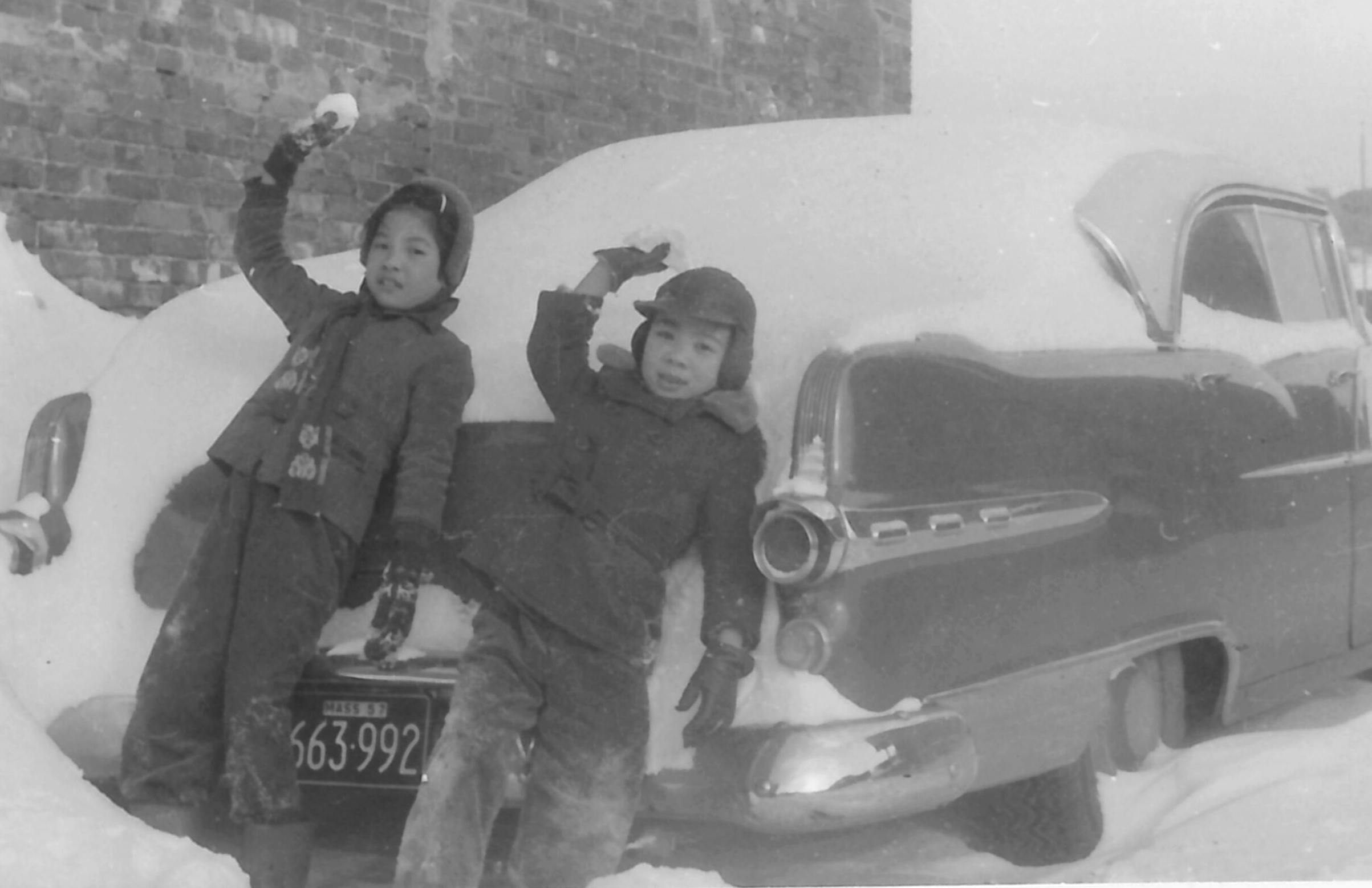
Cousins Cynthia Yee and Albert Yee, playing near 116 Hudson Street, before its demolition for the highway ca. 1957. Photo courtesy of Cynthia Yee
Once the center of thriving Syrian/Lebanese and then Chinese working class populations, and the shops and institutions serving them, Hudson Street became the frontier facing powerful forces that threatened the Chinatown neighborhood.
Boston’s West End is widely recognized as the first neighborhood to be decimated by the federal urban renewal program, yet the process of reorganizing the city had already begun in Chinatown. From 1954 through the 1960s, the twin public forces of urban renewal and interstate highway construction hacked away at the neighborhood. Highway construction took one-third of the housing stock, and then three acres of land went to hospital and university construction.
On Hudson Street alone, road construction demolished sixty buildings and the even-numbered flank of the street. What remained after for decades was the odd-numbered Hudson Street row houses facing the blank concrete wall of Interstate 93. The Busy Corner Spa; St. John of Damascus Orthodox Church; Kin Company grocery; and the homes of Albert Woo, Salma Hadaya, Bak Moy, and Hee Wong were all gone.
Residents remembered, “They told everyone that they had to sell, they had to move, and that was it… They took all of Chinatown. They took Albany Street, Hudson Street. That was half the Chinese community originally. That’s what forced the Lebanese out, the Syrians out, and the Chinese out…The residents and businesses would be served with a notice, a piece of paper either tacked to the door or handed to the resident or business person, giving them sixty days to vacate the premises.”
This was a bitter pill for the former residents, and for many years, they would organize periodic reunions and remembrances of the neighborhood life lost on the street. However, after many decades, the community was able to reclaim a sliver of the lost land that today hosts One Greenway, 66 and 88 Hudson, built by the Asian Community Development Corporation. The enduring memory of the old Hudson Street neighborhood’s strong community fabric has inspired new generations of activism and community-building.
Yet, that sweet memory of simple, youthful play remains. If you were to ask us, former children of Hudson Street, what it was like to live there, each of us will tell you about each house and who lived in it, every rail we slid down, every sidewalk we traversed, every pole we climbed, every stoop we sat on, and every face. It was the landscape of our childhood: always sunny, always a playmate nearby. The street was ours to share and in which to create imaginary worlds, a place where we played games of our own invention and making. Implicit in the freedom we were given was the trust of our parents that we would always choose to do the right thing.
Source: Cynthia Yee, a Hudson Street resident displaced by the construction of the Central Artery in 1962. If Hudson Street Could Talk, Hudson Street Chronicles.
Learn More
Check out more resources submitted by our community.