
International Ladies Garment Workers Union
"The group of women workers, we are very powerful."
33 Harrison Ave, Boston, MA 02111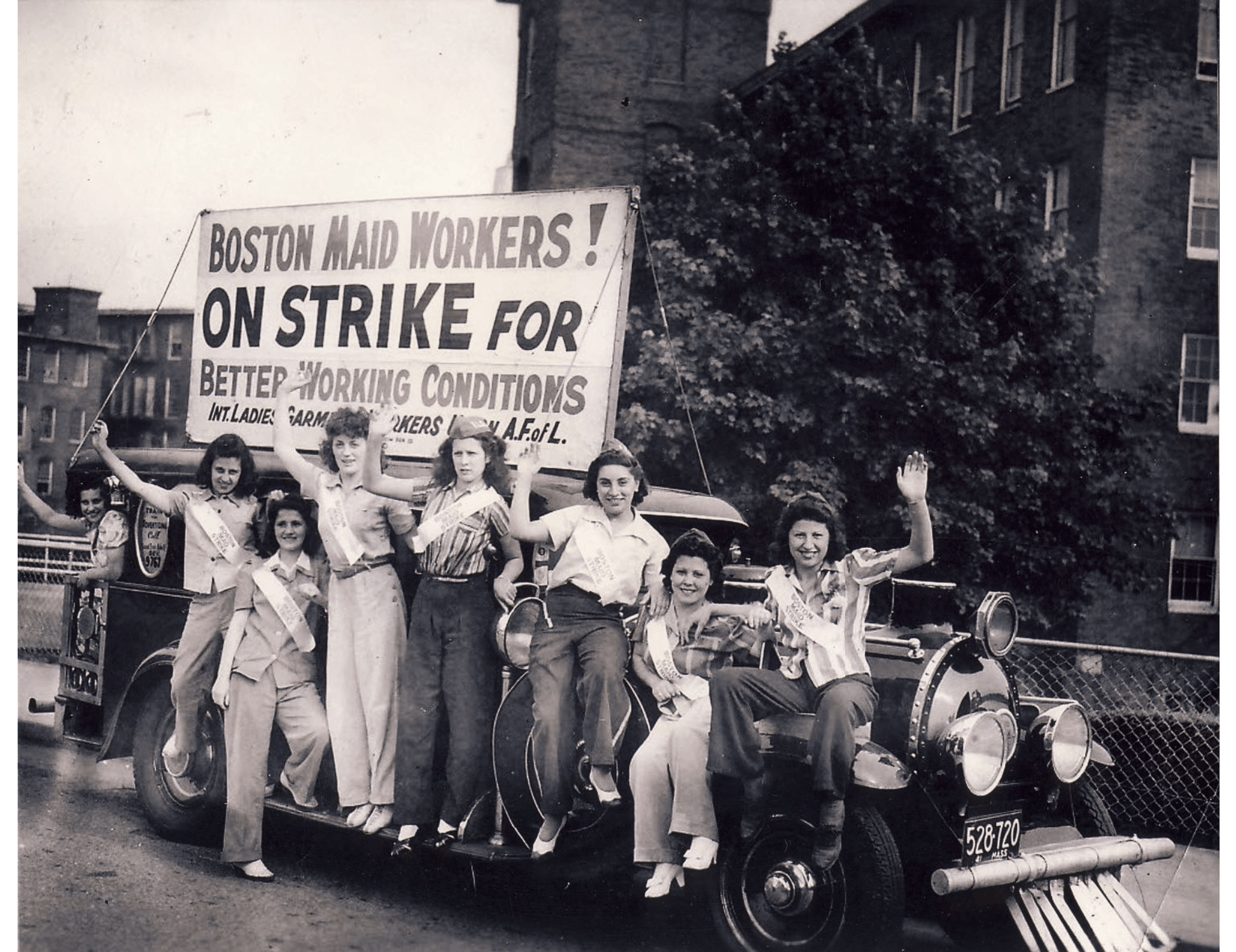
ILGWU workers on strike, Francis Cabot Lowell Mill on Moody Street, Lowell, 1940s. (Photo courtesy of UMass Boston Open Archives)
The International Ladies’ Garment Workers Union (ILGWU) was once one of the largest labor unions in the United States and one of the first to have a majority female membership, with a long history of organizing immigrant workers of all backgrounds. The ILGWU was founded in 1900 via the merger of several garment workers unions in and around New York City, heavily influenced by Yiddish socialism.
Boston, a leading city in the women’s garment industry—with most manufacturers clustered on and around Kneeland Street—was an important center for garment worker organizing. The Denison House, a women-run settlement house on Tyler Street, hosted some of these early trade union meetings.
In 1907, initially against the wishes of the union leadership, two thousand Boston garment workers went on strike to win full recognition of their union from employers. Although the workers ultimately lost the strike, the labor action helped to energize ILGWU organizing and militancy in Boston and far beyond. A two-month labor stoppage in Boston and Cambridge launched in February 1936 by 4,000 garment workers won improved wages and a 40-hour (instead of 52-hour) work week.
In January 1938, the International Ladies Garment Workers Union (ILGWU) purchased the eight-story building at 33 Harrison Avenue to house its New England offices. The union renovated the premises to accommodate an ILGWU radio station as well as a health center, one staffed by 24 physicians and specialists, to provide medical care to 15,000 union members from Boston and its vicinity.
The membership of the ILGWU in Boston reflected the garment industry’s workforce: mainly immigrants, initially people of Polish and German (mostly Jewish) descent, with many of Italian descent as well. The ILGWU grew to about 450,000 members across the United States at its height in the 1950s. With the repeal of exclusion laws following World War II and liberalized immigration quotas in the 1960s, Chinese immigrant women transformed the local garment industry workforce, becoming the majority of the ILGWU membership here by the 1980s.
Garment factories provided an entry into the workforce for Chinese immigrant women. The work required little English fluency, sometimes with flexible hours or the ability to bring work home. ILGWU members had the added benefit of health coverage for families in which the men often worked in restaurants with no benefits. With the closure of many garment factories from the mid-1980s on, rank-and-file Chinese garment workers led a public campaign to demand job retraining that established New England’s first bilingual workforce training programs.
In July 1995, the ILGWU joined with the Amalgamated Clothing and Textile Workers Union to form UNITE (Union of Needletrades, Industrial and Textile Employees). And in 2004, UNITE merged with the Hotel Employees Restaurant Employees Union (HERE) to create UNITE HERE! Today the union has about 300,000 members in the United States and Canada. The building at 33 Harrison Avenue serves as the headquarters of the union’s New England Joint Board.
Because back then, if you were working in America, if you have a union, you have insurance. Once you're laid off, you won't have insurance. Back then, there was no insurance; that's why, when we were unemployed we didn't have insurance. If you went to look for training class, back then a training class was $5000. I knew it was $5000. $5000 for you to study for a couple of months, and you don't have health insurance, and you need to live, that's why we demanded job training; we demanded family security.
Because the group of women workers, we are very powerful. Because everyone has that kind of compassion, it’s the most important. The men, it's not like they’re not.But to be honest, here in Boston, all of the men work at restaurants. Working at a restaurant the hours are long so for them, it limits them. So, for the women, they are more active and know people's needs and are more meticulous. That's why we women are very aware, everyone is very detailed.
Source: Mee Len Hong, former garment worker leader
Learn More
Check out more resources submitted by our community.
by Saul Danburg, Boston University Graduate School
1936
by Lydia Lowe, Amerasia Journal, 18(1), 1992: 39-48.
1992
Emily Stochl interview with Nick Juravich, Pre-loved Podcast
June 1, 2020
by Albert Anthony Tappé, Department of City and Regional Planning, Massachusetts Institute of Technology
March 10, 1958
by Peter N. Kiang and Man Chak Ng, Amerasia Journal 15(1), 1989: 285-293
January 1989