
Johnny’s Home
"A messenger in the community."
2 Johnny Ct, Boston, MA 02111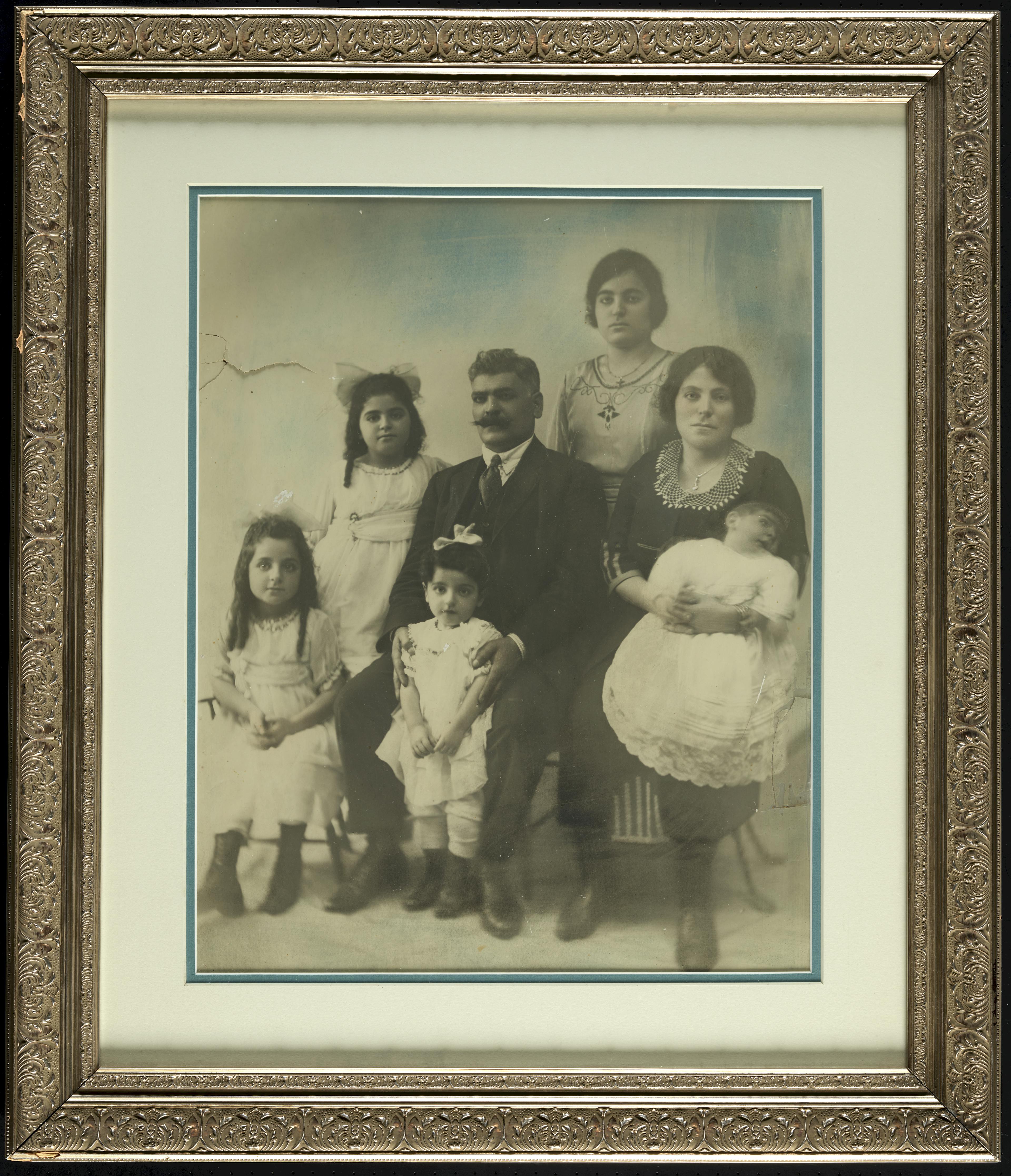
The Assaf family, left to right front: Fahime, Wadia. Second row: Wardé, Georges, Saada holding infant John. Chafika in rear. (Photo courtesy of the Solomon Family, c. 1921)
Johnny Court, formerly called Maple Place, is one of the original small scale streets of Early Greek Revival brick row houses that made up the South Cove neighborhood now known as Chinatown. The street, originally named Maple Place, and built as early as 1837, was first occupied by Irish, Italian and Jewish residents, then Syrian immigrants beginning in the early 1900s, followed by the Chinese.
Syrian immigrants George and Sadie Assaf moved into 2 Maple Place in 1922, In the same year, they welcomed their child John, one of 11 children, who was affectionately nicknamed Johnny. Shortly after Johnny’s birth, he became paralyzed and mostly confined to Maple Place and his neighborhood.
After Johnny moved out in 1956, the people of Maple Place advocated for the street name to be changed to “Johnny Court” in his honor because of the impact he had on the community. John Assaf was not only the face of this street and neighborhood, but his overcoming of his physical challenges also symbolized the resilience that characterized life in the row houses.
Over the decades, the Johnny Court row houses would continue to be home for new generations of immigrant, working class families. Lynn Wah Wong, who lived in this building in the 1970s, said, “Johnny Court was a quaint and quiet little street, the perfect place to raise a little family.”
In the 1980s and 1990s, crime rose in the neighborhood after a Boston decision to site the only adult entertainment zone, known as the Combat Zone, next to Chinatown. During that period, the quiet street of Johnny Court became a common spot for prostitutes to bring their customers. When the Combat Zone waned and luxury developments moved in, many row houses were emptied and became short-term rental properties until the passage of a Short Term Rental Ordinance in 2018.
He used to have a stool, and he would take it to the corner…where the lamppost was, and he’d put his stool and he’d sit there because he’d get tired walking. He couldn’t walk too far…So people passing would say, ‘Johnny, when you see my husband come by, tell him I won't be home until five o'clock. If you see my kids come by, tell them to go to Auntie Sophie's house. We're not home.’ So he was like a messenger in the community. He sat there all the time, and everybody had something to tell him to tell somebody.
Source: Rosanne Solomon, John Assaf’s niece
Learn More
Check out more resources submitted by our community.
by Arthur Krim, City of Boston Landmarks Commission
July 11, 1997
by Michael Liu, University of Massachusetts Press
2020
by Peter J Solomon
April 20, 1997
by Brooks Sutherland, Boston Herald
May 1, 2019
by Milton J. Valencia, Boston Globe
April 30, 2019