
Syriantown
"In Syrian Town, everybody was Auntie."
76 Tyler St, Boston, MA 02111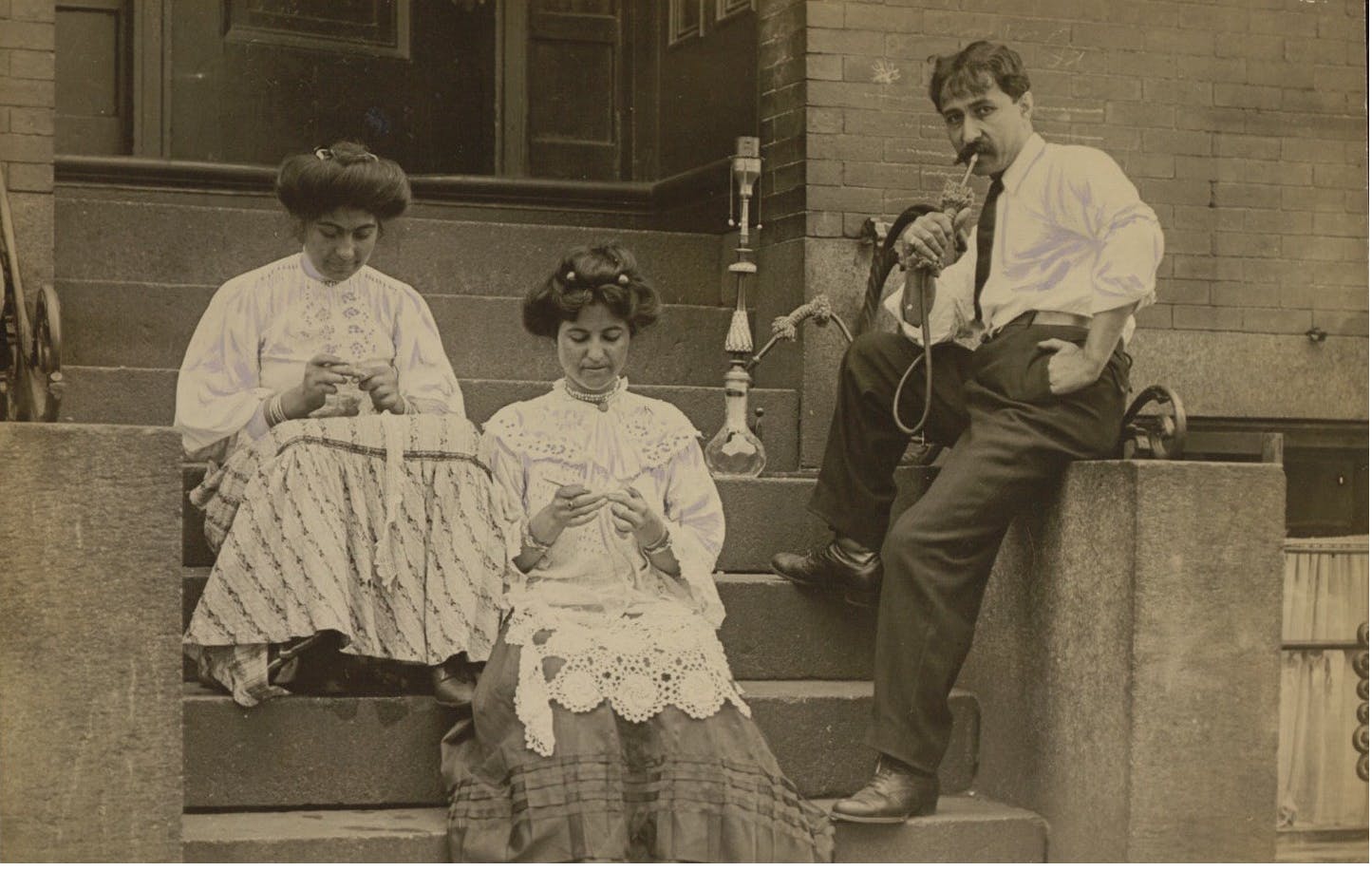
Syrian family sitting on a front step on Hudson Street, 1909. Photographer unknown. (Photo courtesy of Boston Herald, Travel
76 Tyler Street was one of several residences in the neighborhood associated with Lebanese American poet Kahlil Gibran, best known as the author of The Prophet. Following his migration to Boston in 1895, Gibran first lived on Oliver Place. He studied at the Josiah Quincy School and took English and art classes across the street at the Denison House, a settlement house run by elite women’s colleges, with volunteers like Amelia Earhart, who was well-known in the local community. Here, Gibran met his publisher and benefactors and began to enter the literary and Bohemian art world. Although he eventually left Boston for New York, Gibran stayed and wrote here at 76 Tyler Street, in his sister Marianna’s apartment, on frequent extended visits to the city.
Arabic-speaking immigrants from present-day Syria and Lebanon began settling in the South Cove in the late 1880s. The lands they came from were part of the Ottoman Empire, and these new arrivals were then collectively known as Syrians. By 1920, Boston had the third largest population of Syrians after New York and Detroit; by the late 1930s, according to the Boston Globe, the population had reached 15,000.
The early community crowded into brick tenements around Oliver Place (later Ping On Alley) and Oxford Street. By the early twentieth century, social and commercial life in Little Syria, often called “Syriantown” or the “Syrian Colony,” centered on nearby Tyler and Hudson Streets. Nearly all residents were Christian—Maronite, Orthodox, and Melkite. In the 1910s, several Syrians elsewhere in the country successfully petitioned U.S. courts to be legally considered white, and the group was consequently guaranteed the right to naturalization. Muslim Arab immigrants were not granted the same right until 1944.
A common arrangement was to have a dry goods store on the first floor, supplies for pack peddlers in the basement, and living spaces rented out upstairs. Peddling was a common profession among both men and women, first on foot and later by car. But Syrians were also writers, teachers, priests, musicians, factory workers, shoemakers, lacemakers, restaurateurs, bookies, acrobats, and boarding house owners. One such boarding house, run by Khalil and Annie Nassar, sat at 73 ½ Beach Street (site of the Chinatown Gate).
The Syrian and Chinese populations overlapped in the South Cove. Shopkeepers frequently did business with each other, Garment District workers labored in the same factories, and children of both backgrounds, as well as many others, attended the Josiah Quincy School on Tyler Street—now the Chinese Consolidated Benevolent Association community center.
World War I was a period of intensive communal ferment as residents banded together to aid the villages from which they had come, and which were now enduring devastating blight and famine. Numerous civic organizations were formed, among them the Lebanese Syrian Ladies’ Aid Society (still active) and the Syrian American Club. The Arabic newspaper Fatat Boston was launched at 40 Tyler Street to deliver news of both the U.S. and the Middle East.
In the 1920s and 1930s, the Syrian community spread south down Shawmut Avenue. From the 1950s on, however, highway construction and urban renewal accelerated generational and socioeconomic shifts. Residents joined grassroots organizers in Chinatown and New York Streets to push back against demolition plans, but most Syrians eventually left. Today, former residents and their descendants are dispersed, with a significant concentration in West Roxbury, Norwood, and Dedham.
Contributed by Chloe Bordewich and Lydia Harrington, Little Syria Project
We didn't have a playground. We had the streets were our playground. And nobody hurt you and nobody– you weren't afraid of anything. You could stay out. You had to come in when it got dark, of course, but no– parents weren't afraid to allow their children to play outside. Syrian Town was just perfect, I think, as a child, for me.
Source: Betty Lutfy Dimeco
Learn More
Check out more resources submitted by our community.
by Irina Matchavariani and Tiziana Dearing
July 5, 2023