
Parcel C
"We want a community center, not a stinky parking garage."
38 Ash St, Boston, MA 02111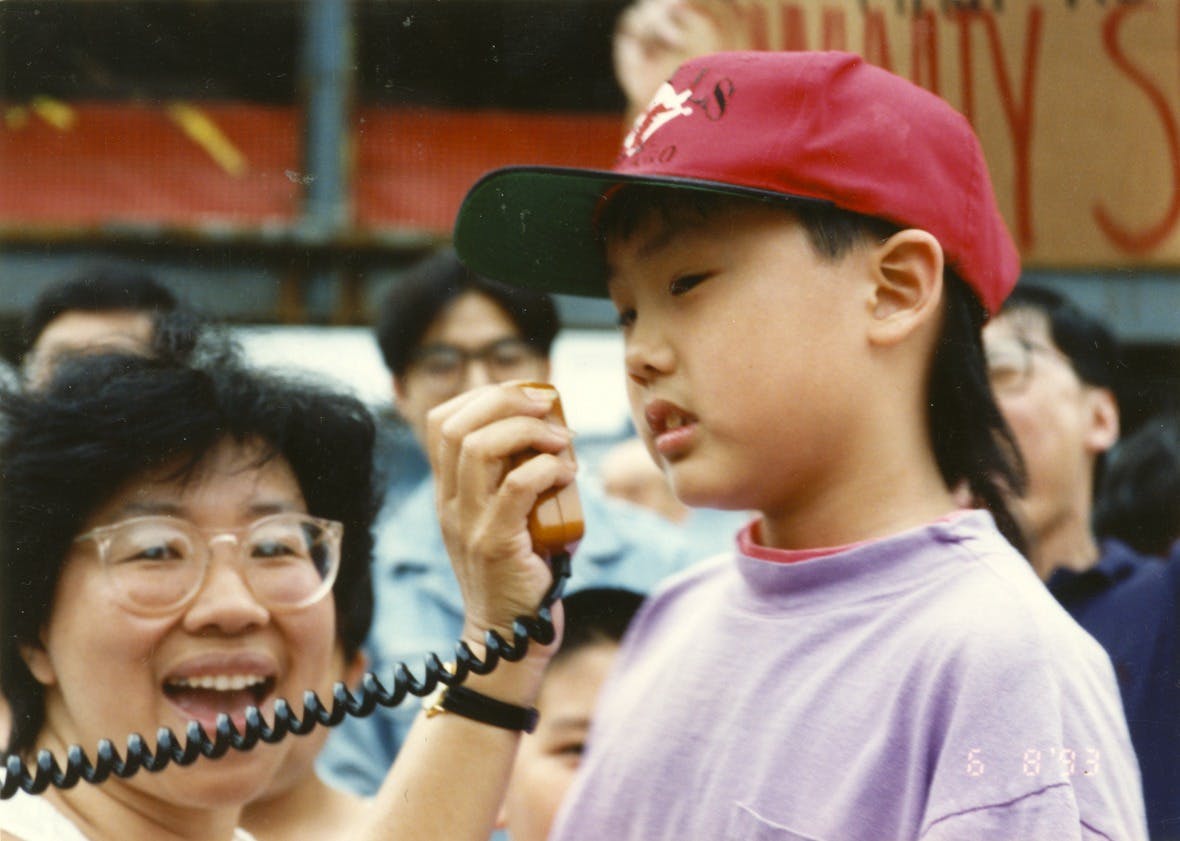
Suzanne Lee holds the bullhorn for fourth grader Mark Liu to talk about why he wants a community center on Parcel C.
The land upon which the Metropolitan was built, known as Parcel C, is an important piece of Chinatown's story.
Parcel C was home to immigrant families until the 1950s, when most of these row houses were razed as part of the federal Urban Renewal Program. In the 1970s, activist volunteers began to utilize a vacant row house at 34-36 Oak Street to provide community services.
To highlight the community's claim to the land, the Quincy School Community Council (now the Boston Chinatown Neighborhood Center) brought community members together to paint the Chinatown History Mural designed by artists David Fichter and Wen-ti Tsen on the 34-36 Oak Street row house. A replica of the mural can be seen inside the Boston Chinatown Neighborhood Center lobby at 38 Ash Street. The City of Boston deeded the building to the Center for $1 in 1987, after defeating a legal challenge by Tufts-New England Medical Center.
For over a decade, the community opposed three different hospital proposals to build a parking garage on Parcel C. In 1993, the Coalition to Protect Parcel C for Chinatown organized an independent referendum in which community members rejected the latest garage proposal by a large margin of 1692:42. Despite the overwhelming sentiment against the garage, it took eighteen months of protests and petitions for the Boston Redevelopment Authority to designate the parcel for community-oriented development.
Hundreds of residents who opposed the parking garage proposal then participated in community meetings to plan for development of Parcel C, demanding and winning bilingual participatory processes for planning and development review. In 2004, the Metropolitan opened with a combination of market-rate and affordable housing, rental and condominium, and space for community organizations.
The resident awareness and involvement sparked by the Parcel C struggle has continued to endure and shape the Chinatown community.
It was the community residents who won Parcel C back. The community worked very hard to win Parcel C back; it is crucial that the Boston Redevelopment Authority and the developers continue to communicate with the residents on any development plans for Parcel C. No one can just make decisions behind closed doors among themselves without the input of the residents. Whoever plans for its development must listen to the residents' voices.
Source: Henry Yee, Co-chair of the Boston Chinatown Resident Association
Learn More
Check out more resources submitted by our community.
by Andrew Leong, University of Massachusetts Boston
September 1, 1997
List of members of the Coalition to Protect Parcel C for Chinatown
July 14, 1993 & August 3, 1993
List of members of the Coalition to Protect Parcel C for Chinatown
July 14, 1993 & August 3, 1993
April 21, 1998