
Shanghai Printing
"The only Chinese printer in Boston."
16 Oxford St, Boston, MA 02111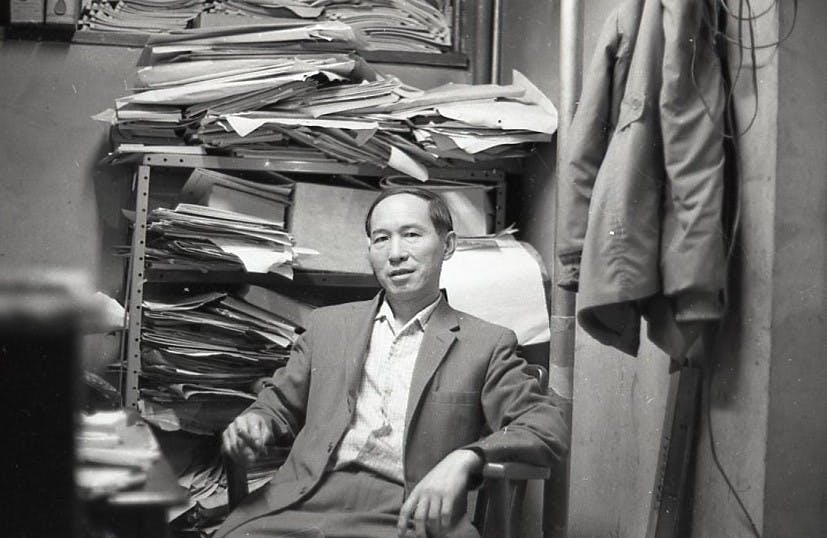
Henry Wong relaxing at Shanghai Printing. (Photo courtesy of Wong family)
Henry You Min Wong traveled by sea, train, and then sea again across the Pacific Ocean and the North American continent to settle in Boston in 1928. Still just a teenager, Wong worked at a laundry, then produced noodles for a different family business, working long hours with little community around him. At age 18, he bought a printing press from his cousin and named it the Shanghai Printing Company.
Wong’s enterprise would become the leading press for the New England Chinese community. With the growth of the Chinese population, there was a demand for Chinese-language materials, from civic documents and social announcements to Chinese restaurant menus and laundry tickets. The Shanghai Printing Company wasn’t just an entrepreneurial success story. It helped to connect the social fabric of the new migrant population as it struggled to find its footing in a new land.
It can be said that immigrants live two lives at once. One in their new home, and another in their native tongue. Prior to the repeal of the Chinese Exclusion Act in 1943, the Chinese population of Boston was sparse and decentralized. News from the homeland was part of what held this new community together, particularly during the wartime years when recent migrants sought updates about China’s struggle against Japanese occupation.
Shanghai Printing would become one of the longest-running presses in the area. Wong brought news and information to the community and was personally involved in helping newcomers
Wong's son Jeffrey took over the business, and, for another 40 years, printed wedding announcements and invitations, business cards and legal documents, rental agreements and news, all the vital printed material to help the Chinatown community prosper.
After 1937, when the Sino-Japanese War began, I bought a 1032-vintage radio to follow the latest news, such as the Battle for Shanghai, the December 8th affair etc. I was translating the news into Chinese and then setting them into print. These fliers were then sold for one or two cents, and everybody was reading them in order to follow the latest development.
Source: Henry Wong, Excerpted from Chinese Progressive Association Oral History Project interview, 1982
Learn More
Check out more resources submitted by our community.
December 14, 1990